
15 Controversial Issues Shaping the U.S. Hotel Industry and Economy in 2026
SPECIAL INDUSTRY RESEARCH | NOVEMBER 12, 2026

The American hotel industry is confronting a fundamental contradiction: Hotels are generating more revenue, but many owners are struggling to convert that revenue into profit.
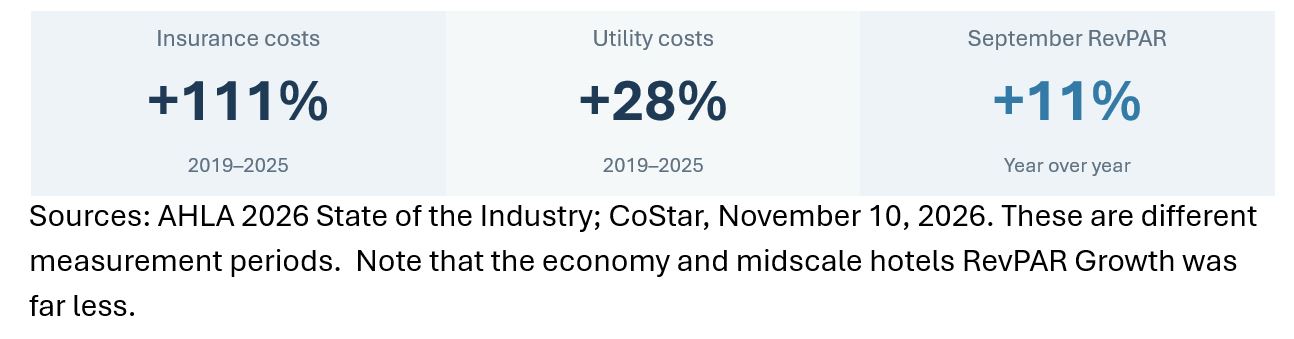
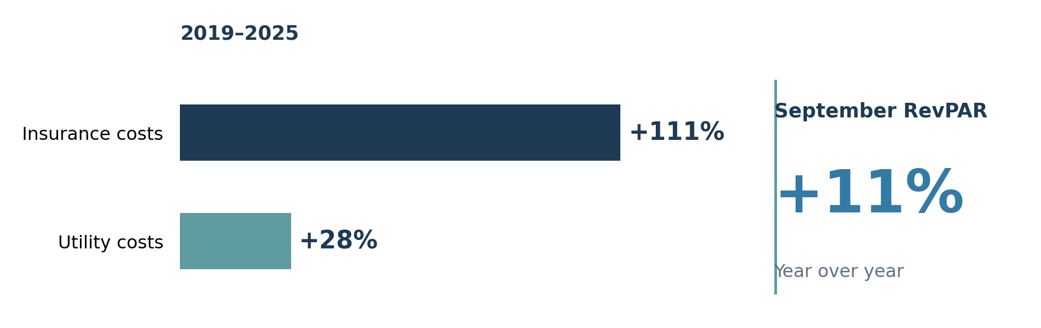
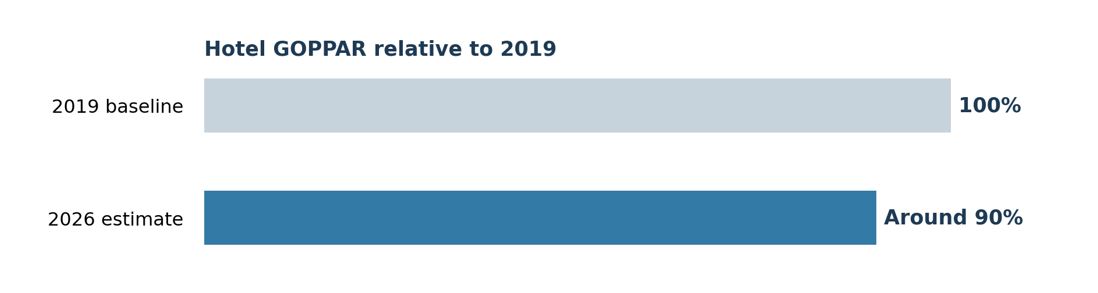
The American Hotel & Lodging Association (AHLA) reports that hotel operating costs have been rising approximately four times faster than revenue. Its 2026 industry report also indicates that gross operating profit per available room remains around 90% of its 2019 level.
Sources:
https://www.ahla.com/sites/default/files/State-of-the-Industry_2026_One-Pager.pdf
https://www.ahla.com/resource/2026-state-industry
Yet the industry is not collapsing. CoStar's September 2026 figures show RevPAR increasing 11% year over year. The challenge is that strong national averages conceal considerable differences between hotel markets, property classes, and individual owners.
Source:
The following issues were selected for their potential to provoke serious discussion among hotel owners, management companies, employees, franchise executives, investors, and policymakers. They involve genuine disagreements over who benefits, who bears the costs, and whether longstanding industry practices remain economically sustainable.
The 15 major controversies
Ranked by their combination of financial importance, industry relevance, and potential for public debate—not by a calculated economic impact score.
1. Are hotel brands getting richer while hotel owners get poorer?
The controversy: Major hotel franchisors collect royalties and system fees, frequently tied to gross revenue, while individual franchisees absorb operating expenses, mortgage payments, property taxes, insurance, and renovation costs.
At the October 2026 Lodging Conference, hotel investors and AAHOA leadership openly questioned whether brand companies' interests remain aligned with owners. They specifically raised concerns about mandatory technology packages, PIPs, escalating fees, and inadequate accountability.
Source:
https://www.costar.com/article/1766645419/hotel-owners-want-more-clarity-understanding-from-brands
Both sides: Franchisors argue that brands provide distribution, loyalty programs, operating standards, and consumer confidence. Owners question whether those benefits justify the total cost, particularly when competing properties under the same brand open nearby.
Question worth debating: Should franchise royalties be based partly on hotel profitability rather than exclusively on revenue?
2. Have online travel agencies become too powerful?
The controversy: Hotels depend on OTAs for reservations, yet frequently surrender substantial commissions and control over how their rooms are marketed.
On October 2, 2026, consumers filed Andrews v. Expedia Group, a federal antitrust lawsuit alleging that Expedia uses contractual rate restrictions and search-ranking practices to prevent lower prices through competing channels. The plaintiffs allege commissions of approximately 15%, potentially rising to 25%–30% with additional visibility purchases. These are allegations, not judicial findings.
Sources:
https://dockets.justia.com/docket/washington/wawdce/2%3A2026cv03743/369601
https://business.cch.com/ald/AndrewsvExpediaGroupIncComplaint1022026100726.pdf
Both sides: OTAs provide valuable customers and international visibility. Hotels argue that their dependence on platforms may prevent them from competing effectively through their own direct-booking channels.
Question worth debating: Should a hotel have the unrestricted right to sell its own inventory at a lower price than an OTA?
3. Why are hotel revenues growing while profitability remains under pressure?
The controversy: Hotel performance is traditionally judged through occupancy, ADR, and RevPAR. But those indicators do not account for rising insurance, payroll, financing, utilities, or distribution expenses.
AHLA estimates that hotel GOPPAR remains around 90% of 2019 levels, despite the industry's recovery in room revenue.
Source:
https://www.ahla.com/resource/2026-state-industry
Both sides: Revenue management professionals emphasize increasing RevPAR and market share. Owners and asset managers increasingly argue that net operating income, cash flow, and returns on invested capital should receive greater emphasis.
Question worth debating: Is RevPAR becoming an inadequate measure of hotel management performance?
4. Are government-mandated hotel wages protecting workers or eliminating jobs?
The controversy: Governments are increasing hotel-specific minimum wages even as operators face higher expenses and uneven demand.
Los Angeles requires covered hotels to pay a minimum of $25 an hour beginning July 1, 2026, along with applicable health-benefit requirements. The wage schedule extends into future years.
Source:
https://wagesla.lacity.gov/hotel-worker-ordinances
Both sides: Labor advocates argue that hotel workers deserve compensation sufficient to live in expensive metropolitan areas. Hotel owners contend that increases unrelated to an individual property's ability to pay can accelerate automation, reduce staffing, discourage investment, and threaten marginal operations.
Question worth debating: Should hotel wages be determined primarily by market competition, collective bargaining, or legislation?
5. Is mandatory daily housekeeping good guest service or unnecessary government interference?
The controversy: Hotels increasingly offer housekeeping upon request, often citing environmental considerations, labor availability, and guest preferences.
New York City's hotel licensing law requires daily cleaning of occupied guestrooms unless guests affirmatively decline. It also restricts the subcontracting of core hotel positions, with some existing arrangements facing a December 1, 2026 compliance deadline.
Source:
https://www.nyc.gov/site/dca/businesses/faq-hotel-licensing-law.page
Both sides: Advocates argue that daily cleaning protects cleanliness, service quality, and employment opportunities. Operators argue that guests should decide whether they need cleaning and that labor allocation should reflect occupancy and guest preferences.
Question worth debating: Should the government determine how frequently a privately operated hotel must clean its occupied rooms?
6. Can the hospitality industry support stricter immigration enforcement and still find enough workers?
The controversy: Immigration restrictions and enforcement create workforce challenges for an industry that depends heavily on housekeeping, food service, and seasonal employment.
An AHLA survey in March 2026 found that more than half of responding hoteliers were somewhat or severely understaffed. For fiscal 2026, the federal government authorized up to 64,716 supplemental H-2B temporary-worker visas to address qualifying labor shortages.
Sources:
https://www.ahla.com/news/ahla-issues-statement-release-supplemental-h-2b-visas
Both sides: Supporters of stricter enforcement prioritize compliance, border security, and protecting lawful employment. Hotel operators emphasize the practical difficulty of filling jobs, particularly in seasonal and rural markets.
The controversy also extends to guest access: In January 2026, the GSA removed a Minnesota hotel from government lodging programs after reservations for immigration enforcement personnel were canceled.
Source:
Question worth debating: Can the industry maintain service standards without a more predictable legal immigrant-worker pipeline?
7. Are America's border and visa policies discouraging international tourists?
The controversy: Restrictions intended to strengthen immigration enforcement and national security can also discourage lawful international visitors.
A Congressional Research Service report updated October 9, 2026, found that international arrivals fell 5.5% in 2025 and were down another 0.4% through June 2026 compared with the corresponding period. Canadian visitation declined especially sharply in 2025. However, international visitor spending showed signs of stabilization later in 2026.
Source:
https://www.everycrsreport.com/files/2026-10-09_R47857_98bade5db7fe1134a4287f693e06d07c12485957.html
Both sides: Policymakers defending stricter screening cite security and immigration compliance. Tourism advocates warn that visa costs, delays, restrictions, and perceptions of difficult entry can redirect visitors toward competing destinations. Restrictions have not caused the decline in international tourism. Political motives in Canada account for much of it. The small remaining percentage reflects tighter visa policies at U.S. embassies overseas.
Question worth debating: Is the United States sacrificing tourism revenue through policies that make international travel more difficult?
8. Are tariffs making hotel renovations and brand conversions financially impractical?
The controversy: Furniture, fixtures, equipment, technology, and construction materials are essential to hotel development and PIPs. Trade-policy changes can increase costs and undermine project budgets.
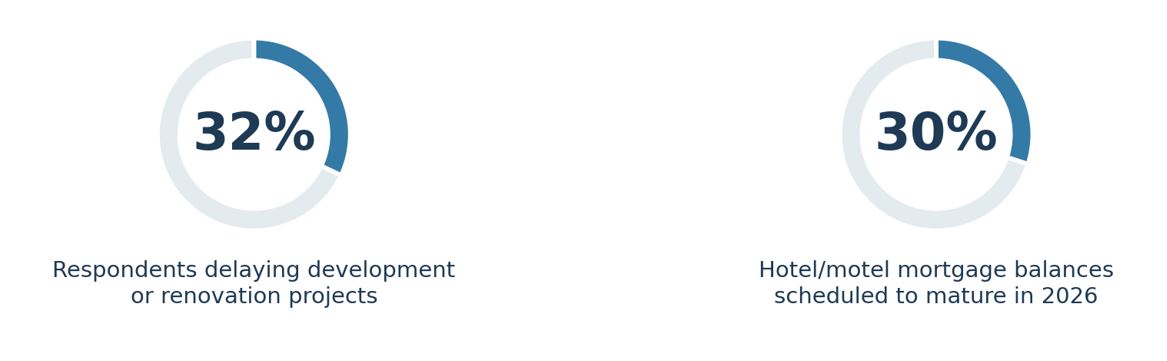
An October 2026 Hotel Management report found that owners are increasingly phasing renovation projects to manage inflation, tariffs, supply disruptions, and financing constraints. An earlier AHLA survey found 32% of respondents had delayed development or renovation projects.
Source:
Both sides: Supporters of tariffs argue that they encourage domestic manufacturing and protect American industries. Hotel owners counter that higher input costs can make renovations uneconomical and discourage new development.
Question worth debating: Should hotel franchisors suspend or modify mandatory PIPs when trade policies substantially increase the cost of compliance?
9. Is the insurance industry pricing hotels out of business?
The controversy: Hotels must maintain appropriate property, liability, and other insurance coverage, but rising premiums and deductibles threaten profitability.
AHLA reports a 111% increase in hotel insurance costs between 2019 and 2025. Insurance specialists also report that hoteliers are paying more for reduced coverage in some casualty insurance markets.
Sources:
https://www.ahla.com/sites/default/files/State-of-the-Industry_2026_One-Pager.pdf
https://www.hoteldive.com/news/hotel-insurance-cost-pressures/832921/
Both sides: Insurers point to severe weather, rising repair costs, litigation, and larger liability claims. Hotel owners question whether pricing adequately reflects individual loss histories and risk-management improvements.
Question worth debating: Should governments intervene in commercial insurance markets when coverage costs threaten otherwise viable businesses?
10. Is America approaching another wave of hotel foreclosures?
The controversy: Many hotels that financed properties under lower interest rates now face refinancing difficulties, capital demands, and tighter lending standards.
The Mortgage Bankers Association reported that 30% of outstanding hotel/motel mortgage balances were scheduled to mature in 2026, the highest maturity share among major property types in its survey.
Source:
Both sides: Lenders maintain that conservative underwriting protects depositors, investors, and financial stability. Borrowers argue that otherwise recoverable hotels can be pushed into distress because of temporary refinancing problems rather than fundamental operational failure.
Question worth debating: Should banks prioritize restructuring loans on viable hotels rather than foreclosing and selling distressed assets?
11. Do Airbnb restrictions protect affordable housing or primarily benefit hotels?
The controversy: Municipal governments restrict short-term rentals to preserve housing, enforce safety requirements, and control neighborhood disruption. Hotels may benefit from reduced competition, while homeowners lose potential income.
A 2025 published economic study estimated that New York City's restrictions increased hotel room rates by approximately $14–$19 nightly. A separate August 2026 working paper found an approximately 87% reduction in affected Airbnb listings but no statistically significant reduction in asking rents during the first year. These studies examine different outcomes and should not be treated as final proof of all effects.
Sources:
https://www.sciencedirect.com/science/article/pii/S0176268025000850
https://papers.ssrn.com/sol3/papers.cfm?abstract_id=7341298
Both sides: Housing advocates argue that residences should serve residents rather than commercial lodging investors. Short-term rental supporters argue that responsible home-sharing helps homeowners pay mortgages and gives travelers more choices.
Question worth debating: Should a homeowner be allowed to rent out an entire residence for short stays under the same general safety and tax standards as hotels?
12. Are hotel resort fees legitimate revenue or deceptive pricing?
The controversy: Mandatory destination, amenity, service, and resort fees have long been criticized for making advertised hotel prices appear lower than the actual price.
The FTC's nationwide rule, effective May 12, 2025, requires businesses advertising short-term lodging to display the total price, including mandatory charges, upfront. It does not generally prohibit hotels from charging such fees. New York City introduced additional consumer-protection requirements in 2026.
Sources:
https://rules.cityofnewyork.us/rule/hotel-junk-fees/
Both sides: Hotels argue that separately itemized charges can support amenities and provide information about services. Consumer advocates contend that mandatory charges should simply be included in the advertised room price.
Question worth debating: Should all mandatory hotel fees be eliminated as separate charges and included in ADR?
13. Will artificial intelligence free independent hotels from OTAs—or strengthen the middlemen?
The controversy: AI assistants are beginning to change how travelers discover, compare, and book hotel rooms. But control over inventory, booking integrations, payments, and customer data remains contested.
In August 2026, Google launched hotel booking through AI Mode in the United States with major hotel brands and travel intermediaries. Separately, Google ended its third-party hotel ad rate-sourcing feature on September 30, requiring affected advertisers to establish direct price feeds to continue eligible hotel advertising.
Sources:
https://blog.google/products-and-platforms/products/search/book-travel-ai-mode/
https://support.google.com/hotelprices/answer/14310302?hl=en
Both sides: Supporters believe AI can reduce traditional advertising and distribution costs by matching guests with appropriate hotels. Others warn that whichever companies control AI discovery and booking infrastructure could become even more powerful than today's OTAs.
Question worth debating: Will AI give independent hotels their first genuine opportunity to compete with global brands, or make them more dependent on technology platforms?
14. Is the American economy creating two entirely different hotel markets?
The controversy: Affluent travelers continue spending on premium travel, while price-sensitive consumers are more inclined to shorten trips, trade down, or avoid paid accommodations.
Bank of America's 2026 research described a K-shaped travel economy, with higher-income households displaying stronger spending growth. PwC's 2026 holiday survey found that expected travel spending declined 24% year over year, despite continuing interest in travel.
Sources:
https://institute.bankofamerica.com/economic-insights/summer-travel-2026.html
https://www.pwc.com/us/holidayoutlook
Both sides: Some operators believe the most sensible strategy is to target guests willing to pay higher rates. Others argue that broadening demand through affordable accommodation, extended stays, and neglected travel segments is essential for sustained occupancy.
Question worth debating: Are hotels becoming too expensive for the very middle-class travelers who historically supported the industry?
15. Should governments use commercial hotels as emergency shelters?
The controversy: Governments contract with hotels to accommodate homeless families, migrants, and other people requiring temporary shelter. Such arrangements can provide emergency capacity and revenue to participating hotels, but they also raise questions about cost, housing suitability, neighborhood impacts, and accountability.
A February 2026 New York City plan identified 112 commercial hotel shelter sites containing approximately 11,486 units, accommodating roughly 8,100 families with children. The city acknowledged that hotels are not designed for long-term family shelter use and outlined plans to transition families into appropriate facilities.
Source:
Federal prosecutors also brought charges in June 2026 concerning an alleged bribery scheme involving a New York City migrant shelter contract. Those charges are allegations against the named defendants, not evidence that hotel shelter contracting generally involves corruption.
Source:
Both sides: Supporters emphasize the need for immediate, humane shelter when conventional facilities are unavailable. Critics question the long-term economics, suitability, and public accountability of commercial hotel contracts.
Question worth debating: Should taxpayer-supported hotel shelter arrangements be temporary emergency measures, or can they become a legitimate long-term part of a city's housing strategy?