Trademark by Wyndham:
Independence That Actually Pays
Trademark Collection by Wyndham
has quietly become the sharpest soft-brand option on the market today — real
Wyndham distribution and loyalty firepower bolted onto a hotel that keeps its
own name, its own character, and its own story. The brand has doubled its U.S.
footprint over five years, passed 100 U.S. hotels and nearly 350 worldwide as
of March 2026, with another 100-plus in the pipeline. Wyndham reports the
disclosed Trademark portfolio drives 74% total U.S. central contribution, with
43% of stays coming from Wyndham Rewards members. Overall assessment: 8.5 out
of 10, climbing to 9 for the right conversion property.
Why this
matters to you: If you're sitting on a good independent hotel and weighing a
conversion, the brand you choose either protects the equity you've already
built or erases it. Trademark is built specifically not to erase it.
Independence Redefined, Not Independence Surrendered
Every hard-brand conversion
asks the same question: how much of your hotel are you willing to give up?
Standardized signage. A prototype lobby. A floor plan built for a market that
isn't yours. Trademark refuses to ask that question in the first place. Wyndham
built the brand for owners who want the machinery — distribution, loyalty,
reservations, credibility — without surrendering the name over the door. The
company calls it "Independence Redefined," and for once the marketing
line and the product actually match. The architecture stays. The F&B stays.
The meeting space stays. The local personality stays.
Hotel at the Lafayette NY, Genuine landmark architecture
The Numbers Back Up the Story
Momentum here isn't hype — it's
arithmetic. As of March 2026, Trademark had cleared 100 hotels in the U.S. and
nearly 350 worldwide, with another 100-plus in development. Wyndham says the
U.S. portfolio has doubled over five years and calls Trademark the
fastest-growing U.S. soft brand by hotel additions over that stretch.
The commercial case is stronger
still. For 2025, Wyndham reports 74% total U.S. central contribution for
disclosed Trademark hotels, with 43% of stays booked by Wyndham Rewards
members. Worth flagging plainly: that figure is Wyndham-reported franchise data,
not an independently audited study. Even discounted for the source, those are
the kind of numbers that move an owner's P&L, not just a marketing deck.
The Field: How Trademark Stacks Up
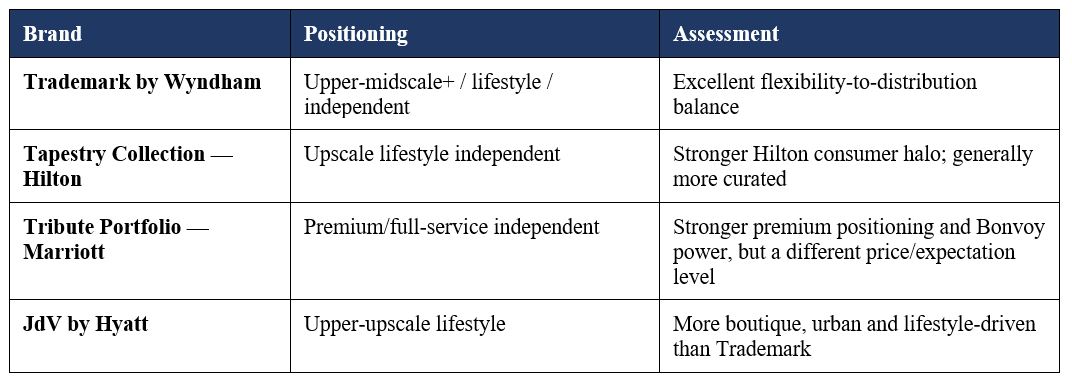
Tapestry Collection by Hilton
is probably the closest direct comparison on the lifestyle side of the field,
with Tribute Portfolio and JdV by Hyatt rounding out the set at different price
points.
Tapestry Collection by Hilton
pulls a step further toward curated lifestyle territory. It crossed 200 open
hotels in 2026, with nearly 150 more in the pipeline, and the Hilton Honors
halo gives it a real edge in immediate consumer recognition — especially among
business travelers.
Tribute Portfolio plays a
different game entirely. Marriott positions it at the premium, full-service
end, wired into Bonvoy's considerable distribution muscle. It's an excellent
product — just not a straight Trademark substitute, because both the property
and the guest walking through the door carry higher expectations.
JdV by Hyatt sits further still
toward boutique. Hyatt categorizes it as upper-upscale, typically 50 to 250
rooms, built around neighborhood feel and social atmosphere rather than
commercial scale.
The Trade-Off:
Freedom Cuts Both Ways
Trademark's biggest advantage
is also its only real vulnerability. Because Wyndham refuses to force every
hotel into the same mold, a Trademark property can be exceptional, merely good,
historic, contemporary, resort-driven, or entirely conventional — the brand
doesn't promise a single, predictable guest experience the way Tapestry or
Tribute does. That's the price of refusing corporate uniformity: less
predictability at the front desk, more upside for the owner who already has
something worth preserving.
Stone Hill Kansas 9.4/10 Public Score
The Stakes
For a strong independent hotel
with meeting space, a working restaurant or lounge, local name recognition, an
unusual building, or simply a story worth keeping, defaulting straight to a
conventional hard-brand conversion is the wrong first move. Wyndham built
Trademark precisely for that property — urban, resort, or secondary-market,
business or leisure — and backed the pitch with commercial numbers to prove it.
Skip that evaluation and the
owner is choosing between two bad outcomes: strip the hotel of everything that
made it worth buying, or stay independent and leave Wyndham's reservation and
loyalty engine — and the revenue that comes with it — entirely on the table.
Trademark exists so an owner doesn't have to make that choice.
Best of Trademark winner for four consecutive years
Overall assessment:
8.5 out of 10
For the right conversion property:
9 out of 10
Nicholas Vasseghy
Daryon Hotels International, LLC
This article is not a paid advertisement, was not influenced by Wyndham, and reflects the writer’s independent opinion.