
HotelConversion.com
Put
differently: five or six American hotels change direction every day. For some
owners, conversion is a strategic decision made from strength. For others, it
arrives as a deadline, a demand letter, or a brand inspection they cannot
afford to fail.
Never treat a
hotel conversion as a new sign on an old building. It is a capital decision. It
can reshape revenue, operating costs, financing, customer mix, competitive
position, and property value for the next decade or longer.
Owners naturally fixate on the cost of changing brands. The sharper question: what will it cost to stay put? A required PIP can devour millions of dollars without correcting a weak brand fit. Franchise fees keep flowing even when the reservation system contributes too little business. An aging property can spend heavily to preserve a flag the local market no longer rewards.
A typical midmarket conversion or major PIP can run approximately $35,000 to $40,000 per room. For a 100-room hotel, that means roughly $3.5 million to $4 million. And that is before hidden building conditions, financing costs, rooms taken out of service, or revenue lost during construction. Some projects cost less. Major upscale repositionings can exceed $10 million.
The most dangerous conversion is often the one delayed until the owner has lost negotiating leverage. Once termination is imminent, the owner may face fewer replacement brands, less time to secure financing, and mounting pressure to accept unfavorable terms.
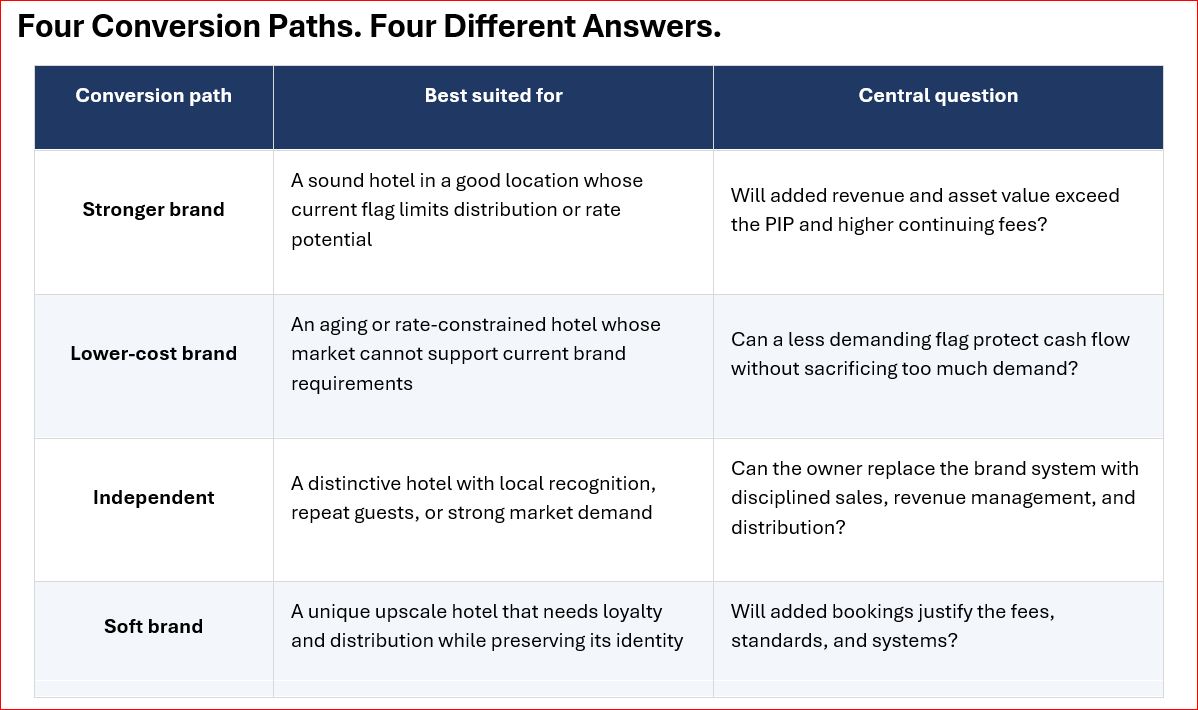
A stronger brand can transform a hotel. The condition: the property must already have the location, room configuration, physical condition, and market demand to support it. Wider distribution, a larger loyalty program, stronger corporate recognition, and better financing prospects can lift occupancy and rate while cutting dependence on high-commission channels.
But prestige is not profitability. A stronger flag pays off only when its incremental revenue and asset-value gain exceed the renovation, franchise fees, operating standards, loyalty charges, and disruption required to obtain it. The owner must evaluate the entire economic relationship. Not the logo.
Some call rebranding to a lower-cost flag a downgrade. That label obscures the economics. If the existing brand demands a renovation the market cannot support, a less demanding brand may preserve the reservation system, ease capital pressure, and improve return on investment.
A hotel charging an $85 average rate should not be forced into a renovation designed for a property capable of sustaining $150. The building must serve its market, not the ambitions of a brand prototype. Disciplined, restrained capital spending can create more value than heavy spending on standards guests will not pay to receive.
Independence hands the owner control over design, pricing, vendors, operating standards, marketing, and the guest experience. It can eliminate substantial franchise costs and free the property from one-size-fits-all mandates. For a hotel with a strong local identity, distinctive architecture, repeat customers, or destination demand, independence may be the most profitable course.
But removing a flag also removes systems. The hotel must replace brand distribution, loyalty demand, corporate sales access, revenue management, training, quality controls, and marketing support. Independence succeeds when the owner builds a stronger operating platform. Not when the owner merely takes down the sign.
Formal terminations tell only part of the story. A brand may demand a PIP the owner cannot finance. It may decline to renew an expiring agreement, suspend reservation access, or require corrective work on a short deadline. The departure may then be recorded as a non-renewal or voluntary exit, even when the owner had no practical alternative.
For these hotels, the clock is running. They need a replacement strategy before revenue falls, employees grow uncertain, lenders get nervous, and guests encounter inconsistent branding. Handled late, a forced conversion becomes a crisis. Handled early, the same conversion can become a repositioning opportunity.
Owners often begin by asking which brands are available. Wrong starting point. The first step is to determine what the hotel can realistically become, and what the market will reward.
The right conversion is not the brand with the most impressive presentation. It is the option that produces the highest sustainable NOI and property value after every capital expense, fee, restriction, and operating requirement is counted.
A hotel owner may face only one or two major conversion decisions in a 20-year ownership period. The brands negotiate these transactions every day. That imbalance matters. Owners need representation from people who understand operations, revenue management, sales, franchise requirements, transition risk, and what happens after the ceremonial ribbon is cut.
HotelConversion.com has completed more than 12 hotel conversions, with three more currently underway. Our work goes well beyond selecting a flag. We evaluate the market, compare brands, review PIPs, project revenue, examine fees, assist with negotiations, organize the transition, and build the post-conversion operating and revenue strategy.
For hotels going independent, we help build everything that must replace the former franchise system: identity, positioning, distribution, website strategy, OTA presence, a local sales program, revenue-management structure, and operating support.
Moving up can unlock demand. Moving down can protect the investment. A soft brand can combine individuality with distribution. Independence can restore control. Even losing a flag can mark the beginning of a more rational, more profitable future, if the owner acts before the market decides for them.
The question is not whether one brand is universally better than another. It is whether the hotel's current identity still serves the building, the market, the guests, and the owner.
Approximately 2,000 U.S. hotels change affiliation every year. Conversion is not an industry exception. It is a recurring part of the hotel life cycle, and an $8 billion market. Owners who approach it with disciplined analysis can turn an unavoidable expense into one of the most consequential value-creation opportunities they will ever have.

Data Note
The figures in
this article are planning estimates compiled from American Hotel and Lodging
Association property and room counts, STR and CoStar affiliation and conversion
research, current franchise disclosure data, and reported hotel PIP costs.
Exact annual totals vary because the industry does not publish a single
national count separating voluntary conversions, terminations, non-renewals,
and other brand departures.
Prepared for
HotelConversion.com September 2026