
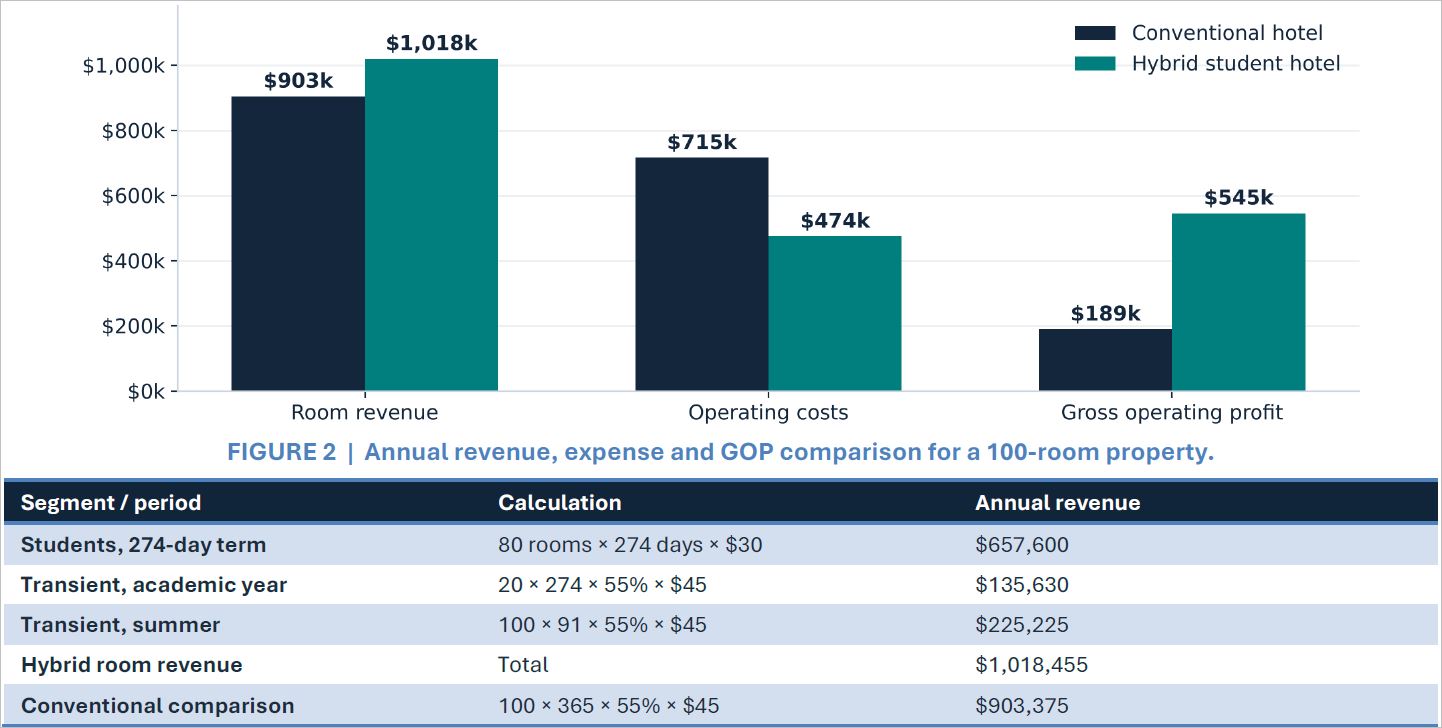
The economics are straightforward: stable academic-year occupancy, lean housekeeping, direct contracting and sharply lower distribution costs can lift gross operating profit — without relying on a single rate increase. Why this matters to you: an owner holding an underperforming economy hotel near a campus may be able to nearly triple gross operating profit in the illustrative case — not by charging more, but by changing who fills the rooms and how they are sold.
Executive summary: the profit is in the cost line
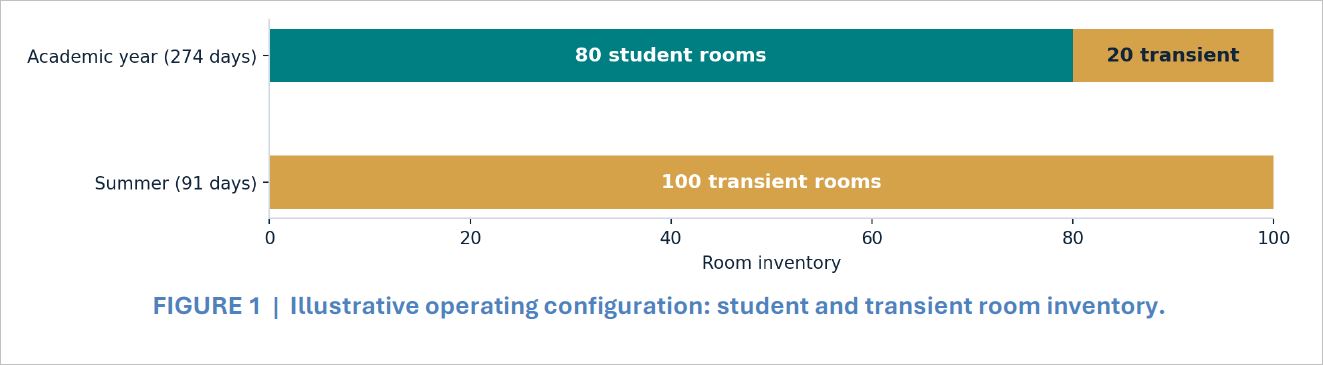
The 100-room illustration is simple. Eighty rooms are
contracted to students for 274 days at a $30 daily-equivalent rate. The
remaining 20 serve transient guests at a $45 ADR and 55% occupancy. Come
summer, all 100 rooms return to conventional travelers for 91 days. Students
receive complimentary monthly cleaning, and they supply — and launder — their
own linens and toiletries.

One caveat before the numbers: these are illustrative
management assumptions, not a forecast for an identified asset. The base case
assumes 100% realization of contracted student-room nights. It assumes no
summer ADR premium and no improvement in transient occupancy. All figures are
in U.S. dollars.
The model targets selected underperforming U.S. economy hotels near colleges or
universities with documented demand for private-room housing. During the
academic year, a portion of the rooms is contracted to students while a
transient inventory stays on the market. In summer, the entire property reverts
to conventional hotel operations. The 100-room property used throughout is
hypothetical — a modeling example, nothing more.
1 | Market proposition:
the gap between hotels and dorms
The demand already exists. American colleges and
universities generate substantial need for student accommodation, yet the hotel
and student-housing sectors still operate as separate categories. A hybrid
product need not imitate the campus dormitory. It can compete on its own terms:
privacy, furnished room quality, private bathroom access, flexibility and
predictable service.
Not every college town qualifies. Priority markets combine
five conditions: unmet or inconvenient student housing demand, an
underperforming existing hotel, compatible zoning, convenient campus access,
and a summer transient market. And one test is non-negotiable: student pricing
must hold up against local off-campus housing on an all-in, per-person basis.
Three customers, one building
2 | Revenue model: contracts first, transient second
Advance contracting is the engine of the model. Management
should open university block negotiations and direct student leasing well
before the school year, set nonrefundable or refundable terms as the law
permits, and run a transparent inventory release schedule. Executed student
contracts establish a forward occupancy base. The remaining transient rooms are
then priced by market forces — real-time demand and displacement value.
A caution on the transient side. A smaller pool may reduce
the number of nightly reservations required, but it guarantees neither a higher
ADR nor higher occupancy. Summer performance depends on local market demand —
and on room readiness after the academic-year transition.
3 | Service model: a leaner operation by design
Student-season operating standards
Summer operating standards
When academic contracts end, the changeover begins. Every room receives a scheduled inspection, repairs, turnover cleaning and a hotel-readiness check. Normal transient housekeeping, guest supplies, laundry, front-desk staffing and summer sales channels then resume. The model budgets $10,000 a year for transition and deep cleaning, separate from ongoing housekeeping and linen expense.
4 | The GOP forecast:
where the $350,000 comes from
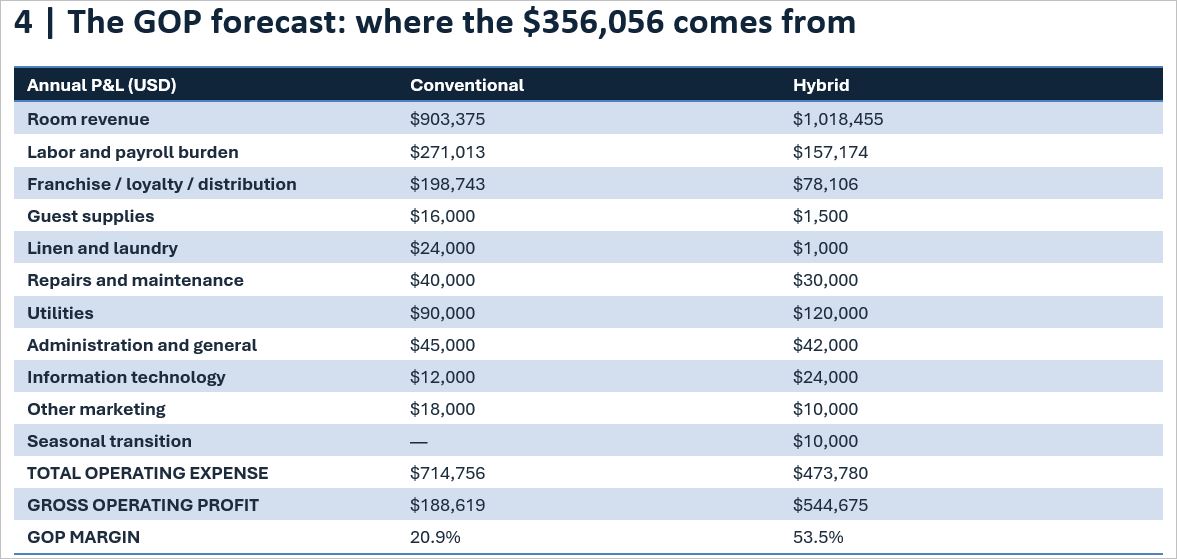
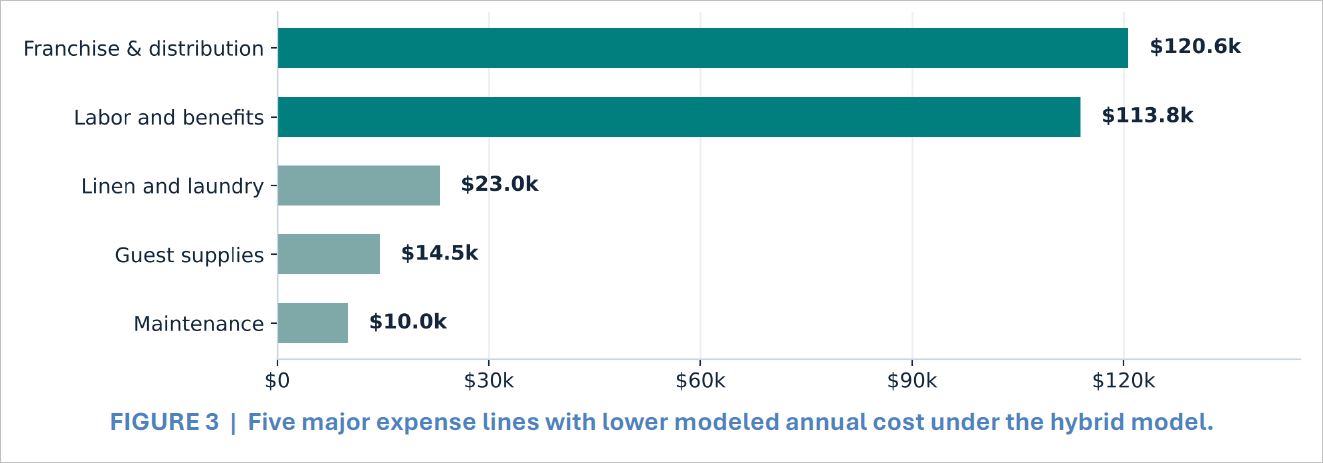
Start with payroll. The hybrid budget sets labor at roughly
13% of academic-period revenue and 24% of summer revenue — $157,174 a year, or
15.4% of annual revenue. The conventional property runs payroll at 30% of
revenue. The hybrid figure already carries monthly student housekeeping and
full summer hotel operations.
Then distribution — the line where franchise economics bite
hardest. The conventional property carries a combined franchise and
guest-acquisition burden of 22% of room revenue. The hybrid pays 2% on student
acquisition and collection, and 18% on transient bookings. All three rates are
scenario inputs, not national benchmarks. The model also assumes the hybrid may
operate without an ongoing hotel franchise.
5 | Underwriting sensitivity:
what if students pay less?
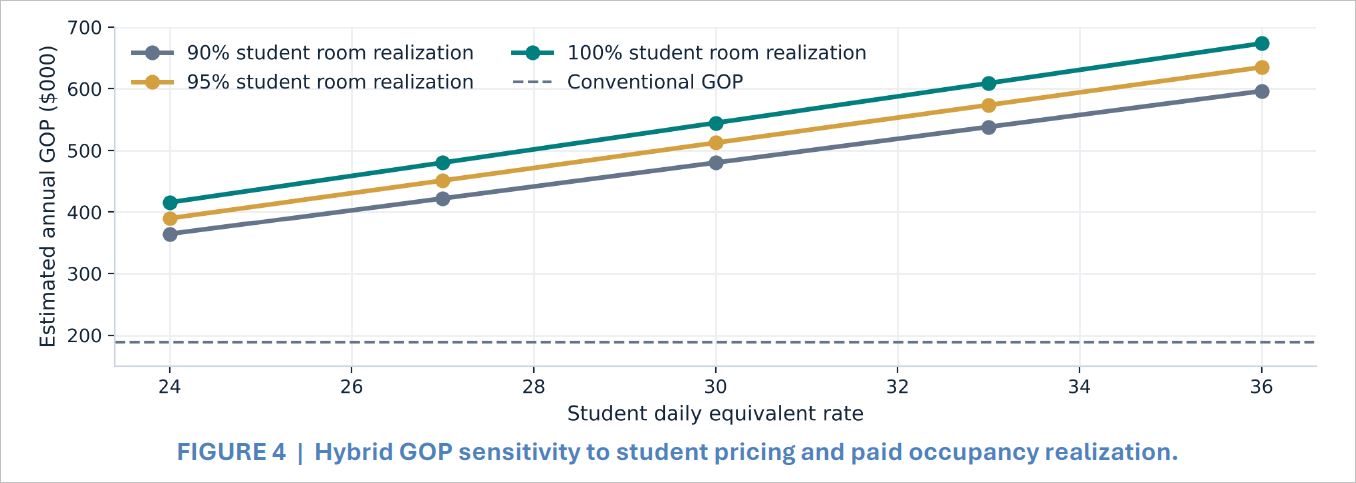
Two variables carry this model: student demand and achievable rate. The sensitivity below stresses both — the effective student rate and the share of contracted student room-nights actually paid. Transient revenue and other modeled costs hold constant, while the 2% student acquisition/collection charge scales with realized student revenue. Labor, bad debt and tenant turnover are not separately adjusted for lower realization.
Core underwriting safeguards: four non-negotiables
6 | Legal, capital and risk:
the fine print that decides the deal
A hybrid conversion is not a rate-plan change, and the
regulatory exposure deserves respect. Long-term student occupancy may trigger
residential tenancy protections, permitting and zoning requirements, fire and
life-safety standards, accessibility obligations, licensing or taxes, and
distinct insurance coverage. Student deposits must conform to applicable law.
And the entire conversion must rest on a legally reliable process for returning
rooms to hotel use every summer.
Brand affiliation and property-improvement-plan obligations
must be reviewed before anyone projects capital savings. Dropping a franchise
may sidestep future brand-standard renovation expense, but termination fees and
mandatory code or asset-condition improvements can survive the exit. PIP
avoidance is a capital consideration — not recurring GOP.
Lower litigation and maintenance costs are possible. They
have not been established here as demonstrated outcomes. Before investment
approval, obtain a property-level legal review, an insurance quotation, a
physical-condition assessment and a conversion budget.
The bottom line: no conversion proceeds until the chosen structure and
operating procedures are confirmed to comply fully with every applicable local
ordinance, law and regulation governing tenancy, room-return rights, deposits,
zoning, life safety and insurance. Treat compliance as a gating condition — on
equal footing with demand validation and CapEx budgeting.
7 | Implementation:
phase by phase, metric by metric
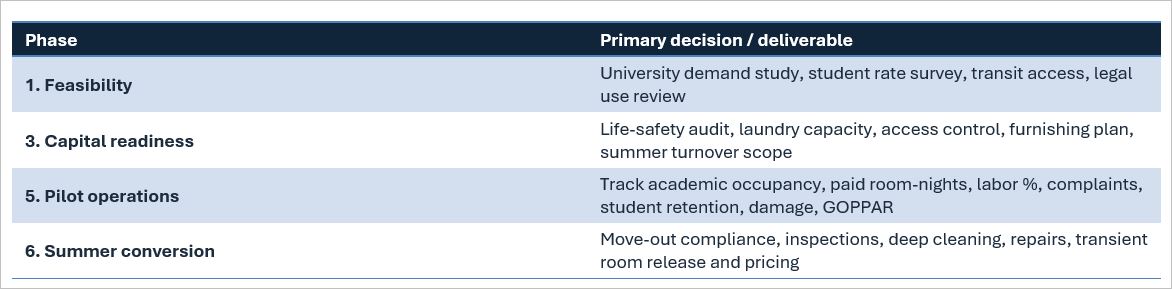
Governance means watching the numbers that matter: paid student room-night realization, student acquisition cost, academic-year occupancy, transient contribution, labor as a percentage of total revenue, utility expense per occupied room, room-turnover cost, delinquency, resident incidents, monthly cleaning compliance, summer readiness days and GOPPAR.
8 | Investment conclusion: worth a controlled pilot
The verdict: the hybrid college inns is a defensible
repositioning hypothesis for selected distressed or underperforming U.S.
economy hotels. In the illustrative 100-room case, annual revenue climbs 12.7%,
modeled operating expense falls 33.7%, and GOP rises from $188,619 to $544,675.
That is strong enough to justify a controlled pilot. It is not an assured
return — and it is not a replicable industry average.
Capital should move only where five conditions hold: (1)
contracted demand is independently documented, (2) student pricing competes
favorably with nearby accommodation, (3) academic-year and summer uses are
legally compatible, (4) franchise exit and conversion costs are quantified, and
(5) the GOP forecast survives conservative downside sensitivity. Skip any one,
and the 53.5% margin stays on paper.
Methodology and source notes
Primary financial source: the operating assumptions supplied
for this concept. Room revenue = rooms × days × achieved occupancy × ADR.
Operating costs are illustrative line-item estimates, rounded to the nearest
dollar. The conventional budget totals $714,756; the hybrid, $473,780. The
figures exclude ancillary revenue, management fees, property taxes, insurance,
FF&E reserve, rent, debt service and conversion capital outlays. In short,
GOP here is neither owner cash flow nor NOI.
External references: CBRE Hotels Research, The Cost of
Franchising – Core and Soft (Aug. 2025); CBRE Hotels Research, For Hotel Owners
Loyalty Program Benefits and Costs Continue to Rise (Oct. 2025); Matthews Hotel
Markets, Gross Operating Profit: definition (Oct. 2026). These sources inform
classification and industry context — not the property-level forecast.
Publication note: an illustrative business plan for
strategic discussion. No specific property, university partnership, occupancy
guarantee, insurance coverage, regulatory approval or investment return has
been verified.